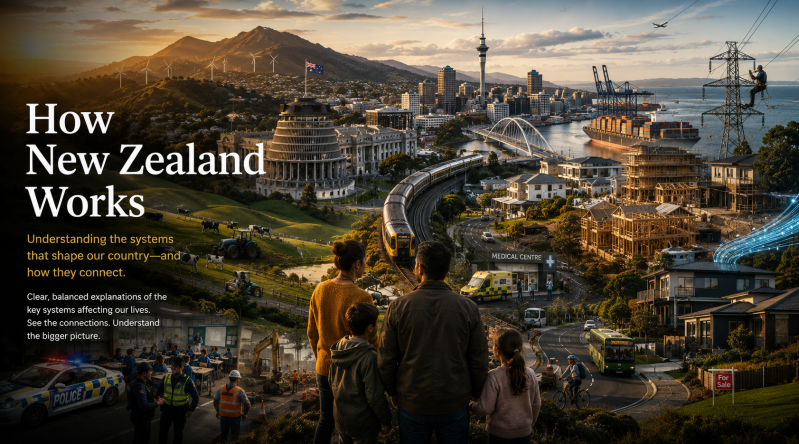
NZ: How It Works

New Zealand is made up of connected systems — from government and the economy to housing, work, and communities.

Simple, clear explanations of how they work — and how they connect to what is happening right now.

How It All Connects

Nothing in New Zealand happens in isolation.

For example:

  • The cost of living connects to inflation, wages, housing, and business costs
  • Housing connects to land, population, regulation, and supply
  • Wages connect to productivity, business conditions, and the wider economy

Understanding these connections helps explain what’s happening — and why.

1. The Big Picture

All articles written April 2026


How New Zealand Works as a Connected System

New Zealand is a small country at the bottom of the world. It has a population of around 5.3 million people, two main islands, and an economy worth approximately US$248 billion. On the surface it can look simple — a quiet, green nation far from the centres of global power.

Read more »

How Power Flows Through New Zealand

Power in New Zealand does not sit in one place. It is not held by a single person, a single institution, or a single system. It flows — through elected governments, through courts and regulators, through markets and money, through iwi and communities, and ultimately through the decisions of everyday New Zealanders.

Read more »

How New Zealand Developed Into the Country It Is Today

New Zealand has one of the shortest human histories of any country on earth. It was the last major landmass to be settled by people, the last to be encountered by Europeans, and one of the youngest nations in the modern world. Yet in that short history it has undergone extraordinary change — from a thriving Māori civilisation, to a British colony, to a progressive welfare state, to a radically reformed free-market economy, to the multicultural Pacific nation it is today.

Read more »

How New Zealand Fits Into the World

New Zealand sits at the bottom of the South Pacific — one of the most remote developed nations on earth. Its nearest significant neighbour, Australia, is 2,000 kilometers away. Its most important trading partner, China, is 10,000 kilometers away. The countries it considers its closest cultural and security allies — the United Kingdom and the United States — are on the other side of the planet.

Read more »

How Global Forces Shape New Zealand

New Zealand did not choose its place in the world. It sits at the bottom of the South Pacific, remote, small, and deeply connected to global systems it did not design and cannot control. What happens in Beijing, Washington, Riyadh, and Brussels flows through into New Zealand's economy, security, environment, and daily life in ways that no domestic policy can fully prevent.

Read more »

2. People & Society


How Population Change Affects New Zealand

Population change is one of the most powerful forces shaping any country — and one of the least visible in daily life. It works slowly, steadily, and across decades. By the time the effects are obvious, the decisions that produced them were made a generation ago.

Read more »

How Migration Shapes New Zealand

New Zealand is, in the most fundamental sense, a country made by migration. Every person living in New Zealand today is either a migrant or a descendant of migrants — from the Polynesian navigators who first discovered these islands around 1280 CE, to the British settlers who arrived in waves from the 1840s, to the hundreds of thousands of people who have arrived from Asia, the Pacific, Africa, and the rest of the world in recent decades.

Read more »

How Inequality Works in New Zealand

Inequality is one of the most discussed and least understood topics in New Zealand public life. People talk about the gap between rich and poor, about housing affordability, about child poverty, about why some communities seem to fall further and further behind while others advance. But the conversation often stays at the surface — the symptoms rather than the system that produces them.

Read more »

How Education Shapes New Zealand

Education is one of the most powerful forces in any society. It shapes what people can do with their lives, what the economy can produce, and whether opportunity is genuinely available to everyone or reserved for those who start with advantages. In New Zealand, education has long been regarded as a national strength — a system that gives children a good start regardless of where they come from.

Read more »

How the Health System Works in New Zealand

Healthcare is one of the most personal and most political things a government provides. When the health system works well it is largely invisible — people get sick, they get treatment, they recover. When it struggles, the consequences are felt in waiting rooms, in delayed diagnoses, in preventable deaths, and in the financial stress of people who cannot access the care they need.

Read more »

How Housing Shapes New Zealand Society

Housing is not just shelter. It is the foundation on which people build their lives — where children grow up, where families form, where communities develop. It determines financial security, health outcomes, educational achievement, and whether people feel they have a stake in society.

Read more »

How Media and Information Shape Public Understanding

Democracy depends on an informed public. People need to know what their government is doing, what problems their country faces, and what different solutions involve — before they can participate meaningfully in decisions about how they are governed. The media — journalism, broadcasting, digital platforms — is the primary mechanism through which that information reaches most people.

Read more »

3. Land, Environment & Resources


How Land Use Works in New Zealand

New Zealand is a small country with a large amount of land — 268,000 square kilometers spread across two main islands and many smaller ones. How that land is used, who has authority over it, and how those decisions are made shapes everything from the country's economy and environment to its relationship with its indigenous people and its prospects in the face of climate change.

Read more »

How Water Shapes New Zealand

Water is the foundation of everything New Zealand produces, drinks, swims in, and builds its clean green reputation on. It fills the rivers and aquifers that irrigate the farms feeding the world. It drives the hydroelectric generators producing most of the country's electricity. It defines the landscapes that draw millions of tourists. And it carries, in its quality and health, one of the most honest measures of how well New Zealand is managing the relationship between economic activity and the natural environment.

Read more »

How Energy Works in New Zealand

Energy is the invisible infrastructure that makes modern life possible. Every light switched on, every vehicle moving, every factory running, every hospital operating — all of it requires energy. How a country generates, delivers, and uses energy shapes its economy, its environment, and its resilience to the disruptions that periodically hit supply.

Read more »

How Farming Fits Into New Zealand

Farming is woven into the fabric of New Zealand — its landscape, its economy, its culture, and its identity. The rolling green hills, the woolly sheep on hillsides, the dairy tankers on country roads at dawn — these are images that New Zealanders carry as part of who they are, regardless of whether they have ever lived rurally.

Read more »

How Climate Change Affects New Zealand

Climate change is not a future threat for New Zealand. It is a present reality. The national average temperature has already risen by 1.2 degrees Celsius over the past century. Sea surface temperatures around New Zealand have warmed 34 percent faster than the global average since 1982. Glaciers have retreated 42 percent since 2005. And the frequency and cost of extreme weather events has risen sharply — with the Cyclone Gabrielle and Auckland Anniversary Day floods of 2023 each producing insured losses more than ten times those of previous major events.

Read more »

How Natural Hazards Shape New Zealand

New Zealand is one of the most geologically active and hazard-exposed countries in the world. It sits on the boundary of two major tectonic plates, is surrounded by the Pacific Ring of Fire, receives intense weather from the Southern Ocean, and has built most of its cities on land that shakes, floods, and occasionally slides.

Read more »

How Conservation Works in New Zealand

New Zealand is one of the most biologically unusual places on earth. For approximately 85 million years it was isolated from other landmasses — long enough for its plant and animal life to evolve along paths found nowhere else. The result is extraordinary: tuatara, a living fossil from the age of dinosaurs. Kākāpō, a flightless nocturnal parrot that can live for a century. Kiwi, birds that lay the largest egg relative to body size of any bird on earth and navigate by smell. Wētā, giant insects that fill ecological roles elsewhere played by small mammals. Carnivorous land snails. Native bats that are the country's only indigenous land mammals.

Read more »

4. Government & Law


How Government Works in New Zealand

New Zealand is a democracy — one of the world's oldest and most stable. It has been electing governments since 1853, enfranchised women before any other self-governing country in 1893, and has maintained an unbroken record of peaceful transitions of power ever since.

Read more »

How Parliament Works

Parliament is where the laws of New Zealand are made, where the government is held to account, and where the representatives of the people meet to debate the decisions that shape the country. It is the central institution of New Zealand's democracy — the place where political power is legitimized and where competing ideas about how the country should be governed are contested.

Read more »

How Local Government Works

Local government is the layer of public administration closest to where people live. While central government sets national policy and provides national services, local government manages the everyday infrastructure and services that shape the quality of life in each community — the roads, the water, the parks, the planning rules, the rubbish collection, and the local decisions about how communities grow and change.

Read more »

How Laws Are Made in New Zealand

Every rule that governs life in New Zealand — from how fast you can drive, to what your employer must pay you, to how a building must be constructed, to what a company must disclose — came into existence through a lawmaking process. Understanding how laws are made is understanding how the decisions that shape society get written down, debated, and enforced.

Read more »

How the Courts Work in New Zealand

Courts are the institutions that resolve disputes, determine guilt or innocence in criminal matters, interpret the law, and protect people's rights against unlawful actions by others — including by the government itself. They are the third branch of government alongside Parliament and the executive, and their independence from political pressure is one of the foundations of a fair and functioning society.

Read more »

How Tax Works in New Zealand

Tax is the primary mechanism through which New Zealand funds its public services — the hospitals, schools, roads, welfare payments, and the hundreds of other things the government provides. Understanding how tax works means understanding not just the rates and rules, but the choices embedded in those rules about who pays, on what, and at what level.

Read more »

How Government Spending Works

Every year the New Zealand government spends well over $100 billion — on hospitals and doctors, on schools and teachers, on superannuation payments to retired New Zealanders, on roads and rail, on the courts, the police, the military, and hundreds of other services and programmes. This spending shapes daily life in ways most people never consciously notice — until something is cut, underfunded, or goes wrong.

Read more »

How Te Tiriti Shapes Modern New Zealand

Te Tiriti o Waitangi — the Treaty of Waitangi — is New Zealand's founding constitutional document. Signed in 1840 between the British Crown and more than 500 Māori rangatira, it established the framework for a shared future between two peoples in these islands. Nearly two centuries later, how Te Tiriti should be interpreted, what obligations it creates, and what role it should play in law and government remain among the most contested questions in New Zealand public life.

Read more »

5. Economy & Money


How the New Zealand Economy Works

New Zealand has a small, open, developed economy at the bottom of the world. With a nominal GDP of around US$248 billion in 2025 — making it the 52nd-largest economy on the planet — it is a mid-sized player in a world of economic giants. What it lacks in size it compensates for in the quality and distinctiveness of what it produces — high-value food and fibre exports, world-class renewable energy, growing technology and digital services, and the tourism draw of extraordinary natural landscapes.

Read more »

How Inflation Works in New Zealand

Prices change. A loaf of bread that cost $3 a decade ago might cost $4.50 today. A rental that was $350 a week five years ago might now be $550. This general rise in prices over time is called inflation — and it is one of the most important forces shaping the everyday economic lives of New Zealanders.

Read more »

How Interest Rates Affect New Zealand

Interest rates touch almost every significant financial decision New Zealanders make. Whether you are taking out a mortgage, running a business, putting money in a term deposit, or simply leaving money in a savings account — the interest rate environment shapes what your money earns and what borrowing costs you. Understanding how interest rates work in New Zealand means understanding who sets them, how they move through the economy, and why their journey from 0.25 percent to 5.5 percent and back down to 2.25 percent in just four years reshaped the financial lives of so many New Zealanders.

Read more »

How the Reserve Bank Works

Every economy needs an institution that manages the money supply, keeps inflation in check, maintains the stability of the financial system, and acts as a backstop when things go wrong. In New Zealand that institution is the Reserve Bank of New Zealand — Te Pūtea Matua. It sits at the center of the country's financial architecture, shaping the cost of every mortgage, the return on every term deposit, and the conditions in which every business in the country operates.

Read more »

How Trade Works in New Zealand

New Zealand cannot feed itself from what its domestic economy alone produces. Or rather — it produces far more food than five million people can eat, and far less of almost everything else. Trade is not a policy choice for New Zealand. It is an existential economic necessity.

Read more »

How the Cost of Living Is Shaped

The cost of living is the amount of money a household needs to cover its everyday expenses — housing, food, transport, utilities, healthcare, and other essentials. It is the most immediate and personal measure of whether an economy is working for the people who live in it. When the cost of living rises faster than incomes, real living standards fall even when the economy is technically growing.

Read more »

How Debt Works in New Zealand

Debt is one of the most powerful forces shaping New Zealand's economy — and one of the least understood. Every household with a mortgage carries it. Every government budget is shaped by it. Businesses depend on it to grow. And the decisions New Zealand makes about how much debt to take on, and how to manage it, affect the cost of living, the health of the economy, and the opportunities available to future generations.

Read more »

6. Markets, Business & Work


How Businesses Operate in New Zealand

Business is the engine of New Zealand's economy. It is how goods are produced, services are delivered, people are employed, and wealth is created. Behind every café, farm, law firm, software company, and construction crew is a set of decisions about how to structure, fund, run, and grow a business — and a framework of law, tax, and regulation within which all of that happens.

Read more »

How the Labour Market Works

Work is at the center of most New Zealanders' lives. It determines income, shapes daily routine, provides purpose, and connects people to their communities. The labour market — the system through which workers find employment and employers find workers — is one of the most important and most closely watched parts of the New Zealand economy. When it functions well, people find meaningful work, businesses get the talent they need, and incomes rise. When it struggles, the consequences are felt in households, communities, and government budgets across the country.

Read more »

How Wages Are Set in New Zealand

Every working New Zealander has a wage or salary — an amount they are paid for the work they do. But how is that amount determined? Why do some people earn far more than others? Why do wages in some industries rise faster than others? And what role does the government, the market, and the law each play in shaping what workers take home?

Read more »

How Supply Chains Affect New Zealand

Every time a New Zealander fills a car with petrol, buys a smartphone, eats a piece of fruit at their desk, or picks up medicine from a pharmacy, they are at the end of a supply chain — a network of producers, processors, shippers, warehouses, and retailers that stretches across continents and oceans. Supply chains are the invisible architecture of modern economic life. When they work, nobody notices. When they break down, everyone does.

Read more »

How Competition Shapes Markets in New Zealand

Competition is the force that keeps prices honest, drives businesses to improve, and ensures consumers get genuine value for their money. When it works well, it is largely invisible — prices are fair, quality improves, innovation happens, and no single company can exploit its customers without losing them to a better alternative. When it breaks down, the consequences show up in grocery bills, mortgage rates, fuel prices, and the choices — or lack of them — that New Zealanders encounter every day.

Read more »

How the Property Market Works

Housing is one of the most important and most contested issues in New Zealand. It affects whether people can afford to live in the city where they work. It shapes how much of their income goes toward rent or mortgage payments each month. It determines whether they can build savings and financial security — or whether they feel permanently locked out.

Read more »

How Consumer Prices Are Set

Every time you pay for groceries, fill a car with petrol, pay a power bill, or renew an insurance policy, you are experiencing the end result of a complex set of forces that determine what things cost. Those forces — supply and demand, business decisions, global events, government policy, and the cost of money itself — interact every day to produce the prices New Zealanders pay.

Read more »

7. Future, Infrastructure & Innovation


How Infrastructure Shapes New Zealand

Most of the time, New Zealanders do not think about infrastructure. They turn on the tap and water comes out. They flick a switch and the lights come on. They drive to work, drop kids at school, visit a hospital when they are sick. All of this depends on a vast network of physical assets — pipes, roads, power lines, schools, hospitals — built and maintained over generations.

Read more »

How Transport Connects New Zealand

Transport is how New Zealand works. It is how people get to work, how children get to school, how groceries reach supermarket shelves, how dairy gets to the port, and how tourists move around the country. Without functioning transport networks, the economy stops. Communities become isolated. Essential services become unreachable.

Read more »

How Housing and Urban Growth Work

New Zealand is a predominantly urban country. Around 84 percent of the population lives in an urban area — a city, town, or suburb. Auckland alone is home to roughly one in three New Zealanders. Wellington and Christchurch between them hold most of the rest of the major urban population.

Read more »

How Technology Is Changing New Zealand

Technology does not change New Zealand from the outside. It changes it from within — in how farms are run, how hospitals diagnose illness, how people bank, how goods are tracked through supply chains, how children learn, and how businesses compete. The changes happening now are not gradual adjustments. They are structural shifts that are reshaping industries, workplaces, and everyday life at a pace that most people and institutions are still working to keep up with.

Read more »

How New Zealand Prepares for the Future

Every country faces risks — from natural disasters, from economic shocks, from geopolitical change, from long-term trends that reshape society over decades. What separates countries that handle those risks well from those that do not is preparation: the thinking, planning, investment, and institutions put in place before things go wrong.

Read more »

How Demographic Change Will Shape New Zealand

Demographics is the study of populations — their size, structure, age, and composition. It might sound dry, but demographic change is one of the most powerful forces shaping a country's future. It determines how many workers there are to support retirees. It shapes demand for schools, hospitals, and housing. It shifts the cultural make-up of communities. And it changes what governments need to spend money on, and where they need to spend it.

Read more »

How New Zealand's Economy May Change

New Zealand's economy in 2026 is recovering from one of its most difficult periods in recent memory. After a contraction in 2024, growth is returning. Interest rates have fallen sharply. Export prices for dairy and meat are strong. Consumer spending is picking up.

Read more »

Why understanding matters

Because when we understand more, we divide less.